Why Choosing the Right Inventory Platform Matters
If you are evaluating medical device inventory software, you are likely trying to solve a real operational problem, not just upgrade technology.
Common challenges include:
- Loaner kits arriving incomplete or late
- Inventory not reconciling with ERP systems
- Limited visibility across reps, territories, or regions
- Reporting that requires manual effort or IT support
Many platforms can improve visibility.
Fewer can support the operational complexity that comes with scale.
The goal is not just to track inventory. It is to run your operations on top of it.
What “Best” Actually Means
There is no single best medical device inventory software.
The right platform depends on:
- Your case volume
- Your inventory model such as loaner, consignment, or trunk stock
- Your ERP environment
- Your growth plans over the next two to three years
What works for a small distributor will not work for a global med tech organization.
Key Features to Evaluate
When comparing platforms, focus on capabilities that impact real operations, not just demos.
Loaner Kit and Consignment Management
- Can the system manage kits, trays, and loose inventory together
- Does it support real workflows such as build, ship, return, and reconcile
ERP Integration
- Does it integrate with systems like SAP, Oracle, NetSuite, or Dynamics
- Can it reconcile inventory automatically
Scalability
- Will the system work at 100 cases per month and 5,000 plus
- Can it support multiple regions or business units
Reporting and Analytics
- Can business users access data without IT involvement
- Does it provide insights or just raw data
Field Usability
- Will reps actually use it
- Does it work in real world conditions such as time pressure or limited connectivity
Types of Medical Device Inventory Platforms
Most solutions fall into three categories.
Simplicity First Platforms
These platforms are built for smaller teams and distributors. They are easy to implement and cost effective, but often lack the scalability and ERP depth needed as operations grow.
Workflow Focused Platforms
These platforms are designed to improve rep efficiency and case coordination. They are typically strong in usability and adoption, but can be limited when operational complexity increases.
Operations Driven Platforms
These platforms are built for large scale med tech organizations managing high case volume and ERP connected environments. They provide deeper control, analytics, and scalability, but require more alignment during implementation.
Comparing Leading Platforms
Instead of comparing features in isolation, it is more useful to look at how each category performs in real world environments.
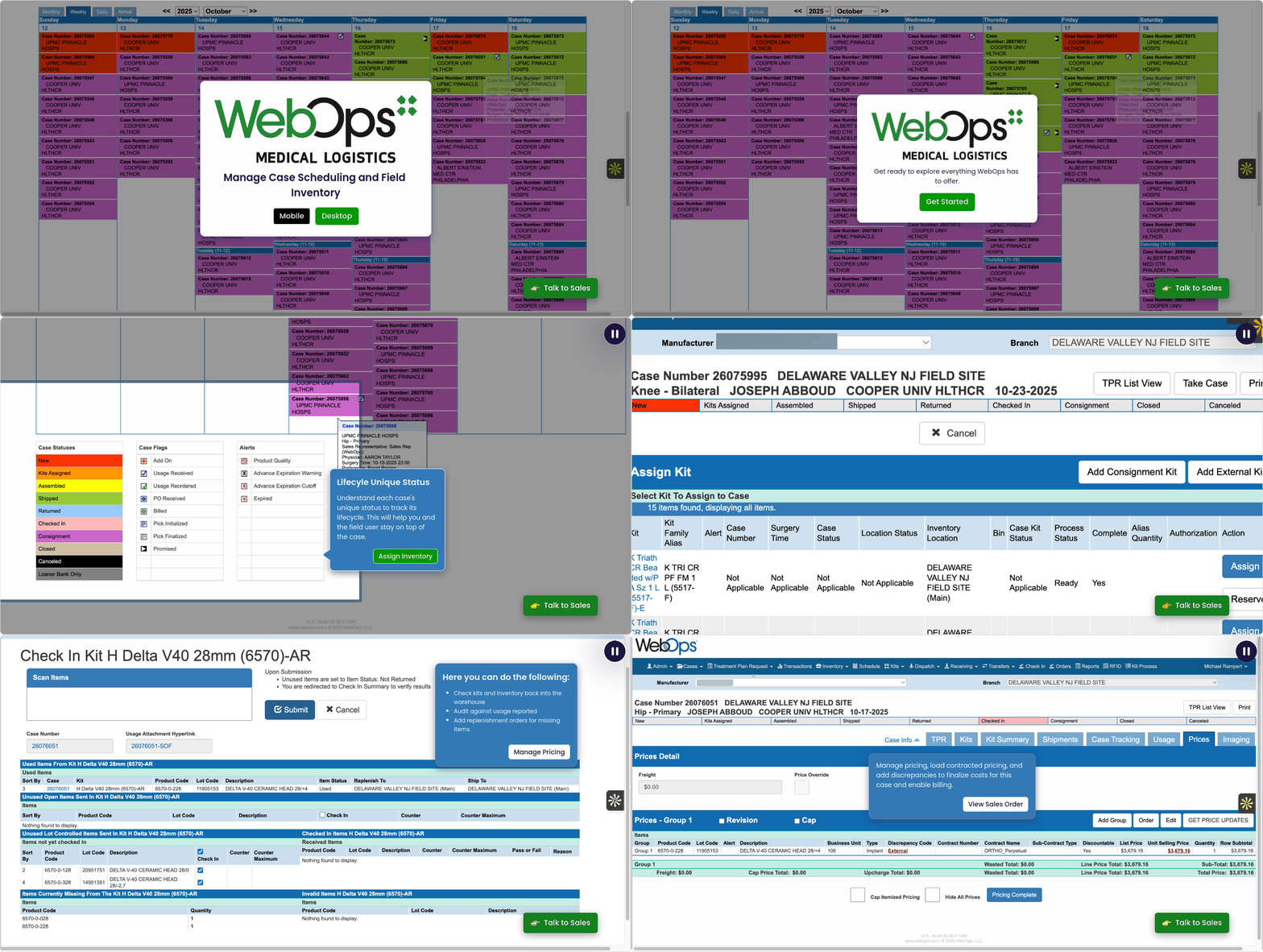
Operations Driven Platforms (Example: WebOps)
Best for:
High volume, complex, ERP connected environments
Capabilities:
- Advanced loaner kit management
- Deep ERP integration
- Multi region support
- High case volume scalability
- Advanced analytics and reporting
Tradeoffs:
More involved implementation and requires operational alignment
Workflow Focused Platforms
Best for:
Teams prioritizing rep adoption and case coordination
Capabilities:
- Strong case scheduling workflows
- Good mobile usability
- Faster rollout
Tradeoffs:
Limited ERP integration depth, basic reporting, and may struggle as complexity increases
Simplicity First Platforms
Best for:
Smaller teams and distributors
Capabilities:
- Basic inventory tracking
- Easy to implement
- Lower cost
Tradeoffs:
Limited scalability, minimal ERP integration, and limited analytics
The Real Difference: Visibility vs Execution
Most platforms help you see what is happening.
- Where inventory is
- What cases are scheduled
- What has been used
But visibility alone does not fix operations.
Visibility tells you what happened. Execution determines what happens next.
This is where platforms separate.
Some are designed for coordination and communication.
Others are built to:
- Reduce inventory levels
- Improve case readiness
- Automate workflows
- Drive measurable operational outcomes
Or put more simply:
Some platforms are very good at talking about the problem.
Others are built to solve it in real world environments.
Where WebOps Fits
WebOps is designed for organizations that have outgrown basic tracking and need a platform that supports real operational complexity.
That includes:
- High case volume environments
- Multi region or global operations
- ERP driven inventory and financial processes
- Teams that rely on analytics to make decisions
It is not designed to be the simplest option.
It is designed to be the system that continues to work as operations scale.
How Buyers Actually Make This Decision
Most organizations do not choose based on features alone.
They choose based on:
- Confidence the system will scale
- Ability to integrate with existing systems
- Trust that data will be accurate
- Alignment with how their teams actually work
That is why evaluation should focus on real scenarios:
- What happens during a high volume week
- How discrepancies are resolved
- How quickly reports can be generated
These are the moments where the right platform proves its value.
Final Thoughts
Choosing the best medical device inventory software is not about finding the platform with the most features.
It is about finding the platform that:
- Matches your current operations
- Supports your future growth
- Continues to perform as complexity increases
Switching systems later is far more costly than getting it right upfront.
See How WebOps Works in Practice
If you are evaluating platforms and want to see how this works in a real world environment:
- Explore how field teams manage cases and inventory
- See how ERP integrations function in practice
- Review operational dashboards and analytics